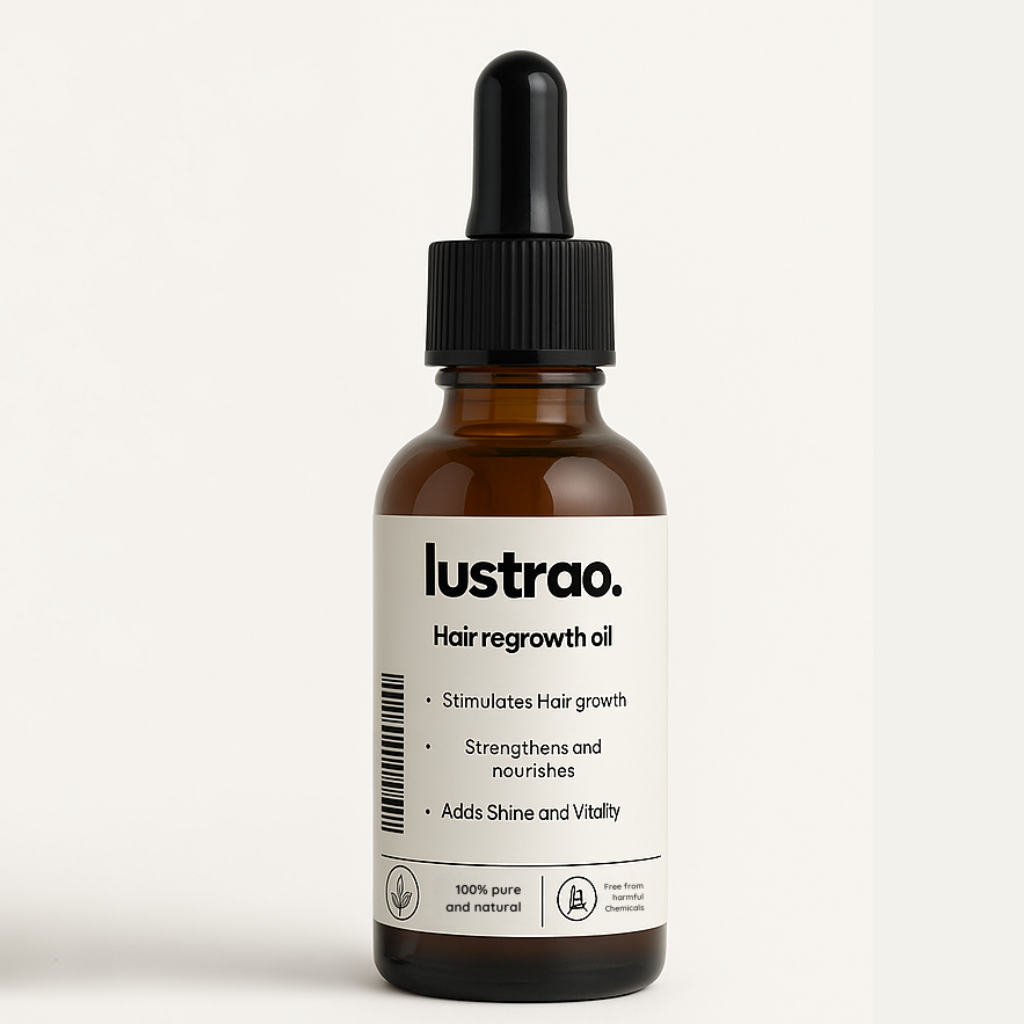


Hair Regrowth Oil for Hair Growth and Hair Loss: A Scientific Review of Rosemary Oil, Peppermint Oil, Panax Ginseng, Castor Oil, Argan Oil & Olive Oil
Lustrao Research · Independent Literature Review · August 2026
Hair Regrowth Oil and Hair Loss:
What the Published Research Actually Shows
A detailed review of the evidence behind rosemary oil, peppermint oil, Panax ginseng, castor oil, argan oil and olive oil, with human clinical studies, human follicle research, animal models and mechanistic evidence kept distinct.
Hair regrowth oils are often discussed as though every ingredient has been tested in the same way. The published research does not support that assumption.
Some botanical ingredients have been studied in humans. Others have been investigated using cultured human hair follicles or dermal papilla cells. Others are supported mainly by animal or laboratory research. Some are better understood as conditioning or scalp-support ingredients rather than direct follicular growth stimulants.
This article is the web version of the Lustrao literature review focused on the six ingredients used in Lustrao Hair Regrowth Oil: rosemary oil, peppermint oil, Panax ginseng, castor oil, argan oil and olive oil. The purpose is to show what has actually been studied, what was measured, and where the evidence remains limited.
About this review. This is a narrative synthesis of previously published research. It is not a new clinical trial and it is not itself a peer-reviewed journal publication. Human clinical evidence is distinguished from human follicle research, animal studies, in-vitro findings and supporting evidence relating to scalp and hair-fibre condition.
Section 1Methodology and Evidence Classification
The underlying literature review was designed as a narrative synthesis of published studies relevant to hair loss, hair growth and the six botanical ingredients in Lustrao Hair Regrowth Oil. Priority was given to peer-reviewed journal articles, indexed research, systematic reviews and major medical or dermatological sources.
The literature was considered across several evidence levels. Human randomized controlled trials were treated as the strongest direct evidence for a clinical outcome. Human clinical and observational studies were considered separately. Human hair-follicle and dermal papilla studies were retained as evidence of biological activity, but not treated as equivalent to clinical trials. Animal and in-vitro findings were reported where they provided relevant mechanistic information.
- Human randomized controlled trial: direct clinical evidence with a defined comparator and outcome.
- Human clinical or observational evidence: human evidence without the full features of a randomized trial.
- Human follicle or tissue evidence: studies using human scalp follicles, dermal papilla cells or related tissue.
- Animal model: in-vivo hair-growth or follicle experiments.
- In-vitro or molecular evidence: cell, biochemical or pathway-level research.
- Scalp and hair-quality evidence: hydration, emollience, elasticity, breakage or related outcomes.
The original research review was not conducted under a formal PRISMA protocol. It used targeted queries against peer-reviewed journals, PubMed and PMC indexed studies, systematic reviews and major dermatology and public-health institutions. It deliberately preserved differences in evidence strength rather than presenting every ingredient as equally established.
Section 2Hair Loss Prevalence and Contributing Factors
Before looking at ingredients, it is useful to understand the scale and variety of hair loss. Prevalence estimates differ because studies use different populations, age groups and diagnostic criteria. Androgenetic alopecia, alopecia areata and stress-related shedding are also distinct conditions and should not be treated as interchangeable.
Approximately 80 million Americans, as a population-level estimate
Institutional epidemiological estimate rather than a single controlled study
Caveat: This is a professional medical association estimate rather than one primary study with a stated sampling methodology.
1,005 men aged 30 to 50
Population-based cross-sectional clinical assessment of hair-loss grade by age group
Caveat: The sample was limited to men aged 30 to 50 and cannot be used as a universal prevalence estimate for other age groups or populations.
Aggregated prevalence figures from multiple primary studies and secondary reviews
Narrative synthesis across different populations and diagnostic thresholds
Caveat: The range reflects differences in study design rather than a single settled worldwide prevalence number.
Global Burden of Disease dataset covering both sexes and multiple countries over three decades
Systematic model-based analysis of global epidemiological data from 1990 to 2021
Caveat: Alopecia areata is an autoimmune condition and is distinct from androgenetic alopecia. The two conditions should not be treated as the same form of hair loss.
Stress and hair loss
1,080 participants
Structured questionnaire covering stress, lifestyle, psychosocial factors and hair-care habits, analysed using chi-square tests and logistic regression
Caveat: Hair loss and stress were self-reported and the study was conducted in one region, so the exact magnitude of the association may not generalise to every population.
Section 3Psychological and Quality-of-Life Impact
Hair loss affects more than hair density. The studies reviewed in the research report describe effects on self-esteem, body image, anxiety, social behaviour and quality of life. The evidence is particularly important in women, who were also noted in the literature review to be comparatively under-represented in parts of the research base.
26 studies including 1,450 participants across the included literature
Qualitative systematic review and thematic synthesis
Caveat: The 78% figure is a pooled finding across qualitative studies rather than the result of one homogeneous clinical sample.
Multinational European population; exact sample size not available in the retrieved abstract
Multinational survey assessing male responses to the realisation of hair loss
Caveat: The study is older and its European population should not automatically be treated as representative of every region.
123 patients with diagnosed androgenetic alopecia
Cross-sectional observational study using validated psychological scales in a hospital dermatology setting
Caveat: A single hospital setting may overrepresent treatment-seeking or more severe cases compared with the general population.
Subgroup analysis within a broader alopecia quality-of-life study
Quality-of-life comparisons by gender, age and alopecia category
Caveat: The source available for this review was a secondary summary, so exact sample size and full statistical methods were not available.
Section 4Minoxidil Efficacy and Real-World Adherence
Minoxidil provides an important conventional comparator because it has a genuine clinical evidence base for hair growth. The literature reviewed for the research paper also shows why efficacy and long-term adherence are separate questions.
400 consecutive AGA patients over a five-year window
Retrospective study of patients prescribed 2% or 5% minoxidil, examining treatment duration, results and side effects
Caveat: The study was retrospective and came from one dermatology clinic, so the exact discontinuation rate should not be treated as a universal population estimate.
27 studies involving 4,294 participants
Systematic review and meta-analysis assessing hypertrichosis with oral and topical minoxidil
Caveat: The pooled literature was highly heterogeneous, with I² reported at 98%, limiting the precision of the combined 23% estimate.
- Minoxidil has a genuine clinical evidence base for hair growth.
- Efficacy alone does not guarantee long-term adherence.
- In the 400-patient retrospective study, discontinuation was common and was associated strongly with adverse effects.
- The hypertrichosis meta-analysis shows that side-effect frequency and treatment discontinuation are separate outcomes.
Section 5Botanical Ingredient Evidence
The six ingredients in Lustrao Hair Regrowth Oil do not have equal evidence. The original research review deliberately preserves this variation. Rosemary has the strongest direct human clinical trial. Ginseng has substantial human follicle and mechanistic research. Peppermint has notable controlled animal findings. Castor and argan are better supported for conditioning and scalp or hair quality, while olive-derived compounds provide additional preclinical evidence.
| Ingredient | Strongest evidence type identified | Main evidence area |
|---|---|---|
| Rosemary oil | Human RCT | Hair count in androgenetic alopecia |
| Peppermint oil | Animal / controlled | Hair growth, follicle number, follicle depth, IGF-1 |
| Panax ginseng | Human follicle | Follicular proliferation and signalling pathways |
| Castor oil | Mechanistic | Ricinoleic acid, inflammation, conditioning |
| Argan oil | Clinical / cosmetic | Hydration, elasticity, hair quality |
| Olive oil | Preclinical | Olive-derived oleuropein and follicular signalling |
Ingredient 1Rosemary Oil: The Strongest Human Clinical Evidence
Rosemary oil is the most directly studied hair-regrowth ingredient in the Hair Regrowth Oil literature. The central paper is the six-month randomized comparison with 2% minoxidil.
100 men with androgenetic alopecia, aged 18 to 49
Randomized, assessor-blinded, six-month head-to-head trial of rosemary oil and 2% minoxidil, with hair counts and photographic endpoints
Caveat: Single study, single centre, male-only population and comparison with 2% minoxidil rather than 5%. The result does not establish equivalence with the higher-strength formulation.
The review also identified a 2023 study of a rosemary-containing hair lotion in C57BL/6 mice. That experiment reported significant hair-growth activity and provided additional preclinical support, but it used a specific formulated lotion and an animal model.
The evidence therefore supports rosemary as the ingredient with the strongest direct human clinical study among the six, while leaving important questions about replication, broader populations and higher-strength comparators.
Ingredient 2Peppermint Oil: Controlled Preclinical Hair-Growth Evidence
The most important peppermint study in the review is the 2014 controlled model reported in Toxicological Research.
Controlled laboratory hair-growth model with four groups
Saline, jojoba oil, 3% minoxidil and 3% peppermint oil applied topically once daily, six days a week, for four weeks
Caveat: This is preclinical evidence and does not establish a comparable effect in humans.
IGF-1 is involved in hair-follicle growth biology, which provides a possible mechanism for the observed effect. The key limitation remains the absence of an equivalent dedicated human clinical trial in the evidence base reviewed here.
Ingredient 3Panax Ginseng: Human Follicle Research and Ginsenosides
Panax ginseng has a broad research base that reaches beyond the whole extract. Several studies focus on individual ginsenosides and their effects on dermal papilla cells, follicular proliferation and hair-cycle pathways.
Human hair-follicle organ culture supported by laboratory work on 5-alpha-reductase and DHT-related effects
Studies examining red ginseng extract and ginsenosides including Rb1, Rg3 and Ro
Caveat: Laboratory and follicle evidence is not equivalent to a large clinical trial in people.
Human dermal papilla cells, outer root sheath cells and human hair-follicle organ culture
BMP4, cell proliferation and anagen-related hair-follicle activity
Caveat: These are experimental concentrations and laboratory systems. They do not establish the clinical effect of the finished topical product.
Human dermal papilla cells and mouse hair follicles
VEGF-related signalling and follicular vascular support
Caveat: Preclinical evidence without a human clinical endpoint.
Three-dimensional human dermal papilla sphere model
PI3K/AKT, GSK-3beta and Wnt/beta-catenin signalling
Caveat: Cell-model evidence and not a clinical trial.
32 men and women with mild to moderate androgenetic alopecia
24-week prospective randomized triple-blind controlled trial of an herbal combination versus 3% minoxidil
Caveat: Ginseng was one component of a combination formula, so this study cannot isolate the effect of ginseng alone. The sample was also small.
The ginseng evidence therefore extends across human follicles, dermal papilla cells, signalling pathways and at least one clinical combination study. It is one of the more developed botanical research areas in the formula, but the distinction between ginseng alone and ginseng-containing combinations remains important.
Ingredient 4Castor Oil: Ricinoleic Acid, Inflammation and Hair Conditioning
Castor oil contains a high proportion of ricinoleic acid, which has been studied for anti-inflammatory activity. The literature is more established for skin and hair condition than direct follicular regrowth.
Experimental inflammation models
Inflammatory response and ricinoleic acid activity
Caveat: This research concerns inflammation, not direct human hair regrowth.
A 2026 narrative review of castor oil in dermatology also discusses its use in hair care and the possible relevance of ricinoleic acid and prostaglandin pathways. A separate 2022 systematic review found stronger evidence for castor oil in hair luster and quality than in direct hair-growth outcomes.
The appropriate scientific interpretation is therefore that castor oil has a plausible supporting role for the scalp and hair fibre, while direct evidence that castor oil alone creates new follicular growth remains limited.
Ingredient 5Argan Oil: Hydration, Elasticity and Hair Quality
Argan oil is rich in oleic acid, linoleic acid and vitamin E-related tocopherols. The evidence examined in this review is more strongly associated with skin hydration and hair quality than with follicular regrowth.
22 published articles concerning hair-related outcomes for commonly used oils
Systematic review
Caveat: The review covers heterogeneous products and preparations, so absence of strong regrowth evidence should not be interpreted as proof that argan oil has no cosmetic benefit.
Human topical skin study
Skin moisturisation and barrier-related outcomes
Caveat: This is a skin-hydration study and not a hair-follicle regrowth trial.
Argan oil is therefore best understood as a supporting oil for the condition of the scalp and hair rather than as the primary evidence-bearing hair-regrowth ingredient.
Ingredient 6Olive Oil and Olive-Derived Compounds
Olive oil requires careful terminology because the strongest hair-growth paper identified in the literature review studied oleuropein, an olive-derived phenolic compound, rather than olive fruit oil as a whole.
Human dermal papilla cell study plus C57BL/6 mouse model
Dermal papilla cell proliferation and transition into anagen
Caveat: Oleuropein is a specific olive-derived compound, not the same thing as topical olive fruit oil. The result is therefore preclinical evidence rather than direct human evidence for olive oil.
The distinction is important. The study is useful for understanding possible olive-derived mechanisms, but it does not justify treating olive fruit oil itself as a clinically proven hair-regrowth treatment.
Cross-Study SynthesisWhat the Literature, Taken Together, Supports
The six ingredients do not form six identical claims. The research shows a spectrum of evidence, from a human randomized trial to follicle-level experiments, animal models and hair-quality studies.
- Rosemary oil has the strongest direct human clinical evidence among the six ingredients reviewed, based on a six-month randomized comparison with 2% minoxidil.
- Panax ginseng has a broad human follicle and mechanistic literature involving dermal papilla cells, ginsenosides and several pathways associated with follicular activity.
- Peppermint oil has a notable preclinical signal involving hair growth, follicle number, follicle depth, dermal thickness and IGF-1 in a controlled animal model.
- Castor oil has stronger supporting evidence than direct regrowth evidence, particularly through ricinoleic acid and its anti-inflammatory properties.
- Argan oil is better supported for hair quality and hydration than for direct follicular regrowth.
- Olive-derived compounds have interesting preclinical follicle data, but compound-level findings should not be equated with clinical evidence for olive fruit oil.
The literature also demonstrates why evidence should be read at the level of the individual study. A human randomized clinical trial answers a different question from a mouse experiment. A human dermal papilla cell study demonstrates biological activity, but it does not tell us how a finished product behaves on the scalp over six months. A study of hair-fibre elasticity addresses a different outcome from a study that measures follicle number.
Frequently Asked QuestionsHair Regrowth Oil and Ingredient Evidence
TransparencyLimitations of This Review
The published evidence is heterogeneous and the review has limitations of its own. Those limitations are reported because they affect how the evidence should be interpreted.
- This is a narrative literature review prepared by Lustrao. It is not itself a peer-reviewed journal publication.
- No new primary data was collected by or for Lustrao for this review.
- The search was broad and targeted, but it was not a formal PRISMA systematic review with a preregistered protocol and duplicate independent screening.
- Several underlying studies have methodological limitations, including single-centre samples, retrospective designs, self-reported outcomes and laboratory models.
- The rosemary clinical trial involved men only and compared rosemary oil with 2% minoxidil.
- Peppermint evidence identified in the review is predominantly preclinical.
- Ginseng has strong human follicle and mechanistic evidence, but the larger clinical study used a combination formula, so the effect of ginseng alone cannot be isolated from that trial.
- The strongest olive hair-growth study examined oleuropein rather than olive fruit oil.
- Evidence for individual ingredients does not establish clinical efficacy for the finished Lustrao Hair Regrowth Oil as a complete formulation.
Further researchA Public Dataset Identified During the Review
The literature search also identified a publicly available dataset titled Dataset for Evaluating Hair Fall Causes Using Machine Learning Techniques, published by Daffodil International University in June 2024.
717 survey responses covering age, gender, hair-product use, water quality, stress, late-night activity, anaemia, family history and health factors
Direct statistical analysis of associations between reported factors and hair fall
Caveat: A direct analysis would constitute a separate research phase and would require its own methods and interpretation.
Full Reference List
- American Academy of Dermatology Association. Skin conditions by the numbers. aad.org/media/stats-numbers.
- Male Androgenetic Alopecia: Population-Based Study in 1,005 Subjects. PMC2938575.
- Severi G et al. 2023, as cited in epidemiological review material. Preprints.org.
- Comorbidities in Androgenetic Alopecia: A Comprehensive Review. Dermatology and Therapy, Springer Nature, 2022.
- Global sex disparities in lifetime risk of alopecia areata, 1990 to 2021. PMC12462261.
- Stress-Related Hair Loss Among the General Population in Al Majma'ah, Saudi Arabia: A Cross-Sectional Study. PMC10625171.
- Psychological impact of hair loss in women: a qualitative systematic review. British Journal of Dermatology, 2025.
- The psychosocial impact of hair loss among men: a multinational European study. PubMed PMID 16307704.
- Does Hair Loss Impact Mood, Self-esteem, Body Image, and Quality of Life in Androgenetic Alopecia? Annals of Indian Psychiatry.
- Psychological Burden of Alopecia Significantly Impacts Quality of Life. American Journal of Managed Care, 2026.
- Compliance to Topical Minoxidil and Reasons for Discontinuation among Patients with Androgenetic Alopecia. PubMed PMID 37012528.
- Efficacy and safety of minoxidil therapy: a systematic review and meta-analysis weighing the benefits against the risk of hypertrichosis. JAAD Reviews / ScienceDirect, 2025.
- Panahi Y, Taghizadeh M, Tahmasbpour Marzony E, Sahebkar A. Rosemary oil vs minoxidil 2% for the treatment of androgenetic alopecia: a randomized comparative trial. SKINmed. 2015;13(1):15-21.
- Oh JY, Park MA, Kim YC. Peppermint Oil Promotes Hair Growth without Toxic Signs. Toxicological Research. 2014;30(4):297-304. PubMed PMID 25584150.
- Red Ginseng Extract Promotes the Hair Growth in Cultured Human Hair Follicles. PMC4350143.
- Effects of Ginseng Rhizome and Ginsenoside Ro on Testosterone 5-alpha-Reductase and Hair Re-growth in Testosterone-treated Mice. Phytotherapy Research.
- Ginsenoside Rg3 up-regulates the expression of vascular endothelial growth factor in human dermal papilla cells and mouse hair follicles. PMID 24375856.
- Panax ginseng extract antagonizes the effect of DKK-1-induced catagen-like changes of hair follicles. PMID 28849028.
- Ginsenosides in Panax ginseng Extract Promote Anagen Transition by Suppressing BMP4 Expression and Promote Human Hair Growth by Stimulating Follicle-Cell Proliferation. PMID 38246611.
- Hair-Growth Potential of Ginseng and Its Major Metabolites: A Review on Its Molecular Mechanisms. PMCID PMC6163201.
- Hair Growth-Promoting Mechanisms of Red Ginseng Extract through Stimulating Dermal Papilla Cell Proliferation and Enhancing Skin Health. PMCID PMC8531430.
- Ginsenoside Rg4 Enhances the Inductive Effects of Human Dermal Papilla Spheres on Hair Growth Via the AKT/GSK-3beta/beta-Catenin Signaling Pathway. PMCID PMC9706015.
- Lueangarun S, Panchaprateep R. An Herbal Extract Combination versus 3% Minoxidil Solution for the Treatment of Androgenetic Alopecia. Journal of Clinical and Aesthetic Dermatology. 2020;13(10):32-37.
- Girdler K, Cabatu A, Olds H, Potts GA. Use of Castor Oil in Dermatology: A Narrative Review. Cureus. 2026;18(2):e103289.
- Vieira C, Evangelista S, Cirillo R, Lippi A, Maggi CA, Manzini S. Effect of ricinoleic acid in acute and subchronic experimental models of inflammation. Mediators of Inflammation. 2000;9(5):223-228.
- Boddu SHS et al. Anti-inflammatory effects of a novel ricinoleic acid poloxamer gel system for transdermal delivery. PMID 25542985.
- Phong C, Lee V, Yale K, Sung C, Mesinkovska N. Coconut, Castor, and Argan Oil for Hair in Skin of Color Patients: A Systematic Review. Journal of Drugs in Dermatology. 2022;21(7):751-757.
- Boucetta KQ, Charrouf Z, Aguenaou H, Derouiche A, Bensouda Y. Does Argan oil have a moisturizing effect on the skin of postmenopausal women? Skin Research and Technology. 2013;19(3):356-357.
- Mysore V, Arghya A. Hair Oils: Indigenous Knowledge Revisited. International Journal of Trichology. 2022;14(3):84-90.
- Tong T, Kim N, Park T. Topical Application of Oleuropein Induces Anagen Hair Growth in Telogen Mouse Skin. PLOS ONE. 2015;10(6):e0129578.
- Wanitphakdeedecha R et al. Olive leaf extract-containing cream for facial rejuvenation: a pilot study. Journal of Cosmetic Dermatology. 2020;19(7):1662-1666.
- Dataset for Evaluating Hair Fall Causes Using Machine Learning Techniques. Mendeley Data, V1, 24 June 2024. DOI 10.17632/g46n66frrh.1.
Lustrao Hair Regrowth Oil
Six Botanical Ingredients. One Evidence-Based Formula.
Explore the Hair Regrowth Oil containing rosemary oil, peppermint oil, Panax ginseng, castor oil, argan oil and olive oil.
Shop Hair Regrowth Oil View the Published Research
Share